The core proposition, stated plainly: professional print-on-demand for equestrian wear now starts at 20 pieces per color per style. That single number changes the economics of launching a new equestrian brand. It removes the inventory gamble that has historically kept small, design-led labels out of technical riding apparel, and it lets a founder validate fit, fabric, and brand positioning with real riders before committing to a full production run.
A growing market, an evolving product
The equestrian apparel market is growing at a 5.5% CAGR toward $11.89 billion by 2035. The broader equine industry carries an annual economic impact of around $300 billion, with some 27 million people riding every year—a participation base larger than either tennis or golf. This is not a shrinking niche; it is a mass-participation sport with premium spending behavior.
— Global equestrian apparel market size, 2023–2026 (indicative)
Metric
2023
2024
2025
2026
Global equestrian apparel market
value (USD billion)
~6.25
~6.60
6.96
7.34
Implied year-over-year growth
—
~5.5%
~5.5%
~5.5%
Market stage
Recovery and premiumization
Technical wear adoption expands
Baseline technical expectations
New equestrian brand entry
accelerates
Structural indicator
Annual riding participation ~27
million; top five brands ~40% share
Same structural base
Same structural base
Same structural base
The CAGR toward $11.89 billion by 2035. The broader equine industry carries an annual economic impact of around $300 billion,
with some 27 million people riding every year—a participation base larger than either tennis or golf.
The product itself is evolving faster than the brand landscape. Between 2023 and 2026, equestrian wear moved decisively away from “traditional kit with a logo” toward three convergent demands:
Dimension
2023
2024
2025
2026
Technical performance
Premium differentiator in
equestrian wear
Becoming expected in riding horse
wear
Baseline for competitive products
Entry requirement for a new
equestrian brand
Fabric and finishing
Moisture-wicking and basic
stretch
Breathable four-way stretch
adopted
Shape retention and wash
durability emphasized
280+ GSM technical stretch, 15–25% elastane, grip durability as standard
Sustainability
Marketing language
Recycled fibers introduced
Certification increasingly
requested
OEKO-TEX and recycled nylon
treated as sourcing specifications
Customization
Limited color and logo options
Team and stable branding growing
Rider identity and limited
editions expand
Customized equestrian clothing as a standard expectation
New-brand entry route
Influencer-led but
MOQ-constrained
Low-MOQ pilots emerging
Rider-led labels testing direct
channels
20 pieces per color per style POD normalized for market
testing
Representative product focus
Generic equestrian wear
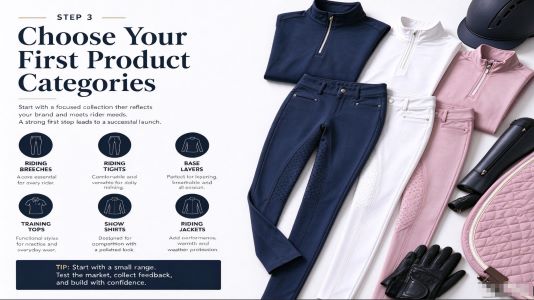
Riding tights and base layers
Competition shirts and breeches
Full capsule: breeches, base
layers, competition shirts, riding tights
The brand landscape reflects this evolution. The top five equestrian apparel brands still hold roughly 40% of the global market,
but influencer-founded and rider-led labels are entering at an accelerating pace, using community trust and direct digital channels to bypass traditional wholesale gatekeepers.
The bottleneck for these new entrants is rarely a design ambition. It is the minimum order quantity.
How to make sure the POD equestrian wear is what you want and be professional
It operates on factory-direct technical patterns, not commodity blanks. It delivers:
l All riding horse clothing are made by the same construction standards used in larger OEM runs, simply executed at 20 pieces per color per style. A new equestrian brand does not have to choose between “cheap and unwearable” and “technically correct but financially reckless.”
l The 20-piece POD model sits between these poles: it eliminates the inventory risk of bulk production while avoiding the performance penalty of generic POD. For a first capsule collection, the landed cost per unit remains manageable, and every piece produced has a realistic path to sale.
l This POD is to get customized equestrian clothing onto real riders in weeks, not quarters. This compresses the feedback loop: fit issues surface before a second production run, colorways can be validated against actual stable lighting, and reorder signals emerge from sell-through rather than guesswork.
Below tables will make you clear in few seconds:
Specification
Equestrian POD requirement
Generic POD limitation
Fabric weight
280+ GSM technical stretch woven
~220 GSM polyester-spandex blank
Elastane content
15–25% for riding posture
Lower, non-riding-specific
stretch
Silicone grip durability
10,000+ abrasion cycles
Not typically rated
Wash durability
50+ washes
Bagging and shape loss common
after one ride
Return rate risk
Controlled via fit and fabric
validation
>30% return rates reported for
unsuitable activewear blanks
Model
Unit cost indication
MOQ
Inventory risk
Technical suitability
Traditional equestrian
manufacturing
$8–$14 FOB per show shirt at ~300
pieces/style
High volume per style
High
Professional
Generic POD
$25–$40 all-in
Low
Low
Poor for riding wear
Professional equestrian POD
Between the two poles; manageable
for first capsule
20 pieces per color per style
Low
Professional-grade construction
The POD workflow: from first contact to delivered order
The process is deliberately linear, because a first-time equestrian brand founder should not need a production background to execute it.
Step
Action
Output
1
Contact operations team
Product categories and target
market confirmed
2
Review catalog
Styles, fabrics, and size ranges
assessed
3
Select styles and provide logo
assets
Production-ready logo and
application method confirmed
4
Submit order requirements
20 pieces per color per style, with size breakdown
5
Confirm total order value and
delivery date
Written pricing, timeline, and
shipping terms
6
Bulk production completion and
photo verification
Pre-shipment quality and
specification approval
7
Shipment
Finished equestrian wear
dispatched
The defining advantage of this POD model is not simply “low MOQ.”
It is the combination of three things that have historically been mutually exclusive for a new equestrian brand: professional equestrian construction, a 20-piece-per-color-per-style entry point, and a workflow fast enough to function as a market test rather than a speculative bet.
A founder can now put customized equestrian clothing—riding horse wear that actually performs under saddle—in front of real riders without committing to hundreds of units per style.
The market is growing, the product category is evolving toward technicality and customization, and the supply chain barrier has dropped to a level that matches the scale of a serious new brand's first move. Twenty pieces per color per style is enough to learn what the market wants; it is no longer necessary to guess.

Address : 3F, NO.2#, NO.1169, Road Jicheng, Tong'an District
Tel/Fax : 18659565121
Whatsapp : +8615959180430
Email : Sales_alin@alproapparel.com